History of Madness by Michel Foucault
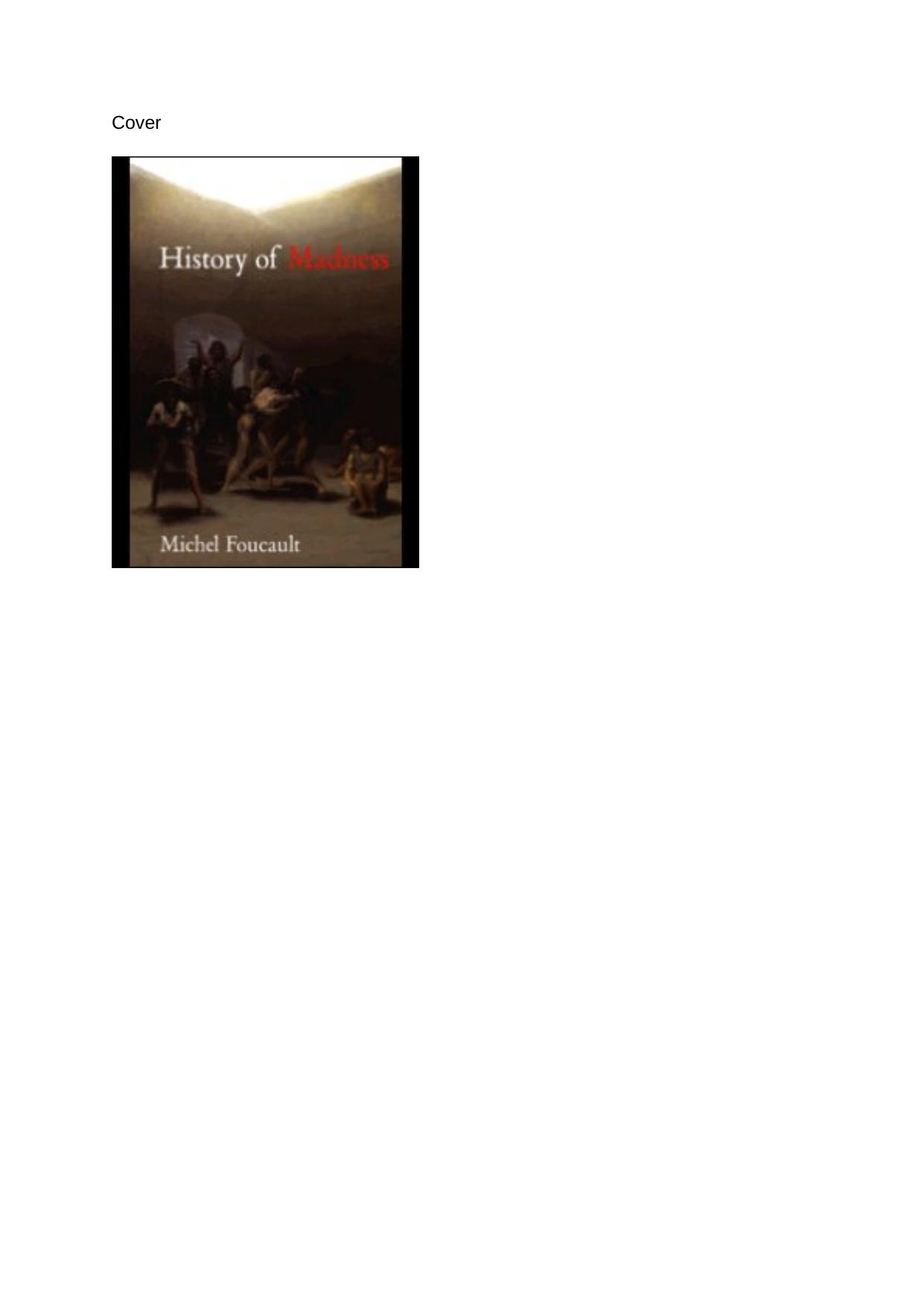
Author:Michel Foucault [Foucault, Michel]
Language: eng
Format: epub, pdf, mobi
ISBN: 9781134473793
Publisher: Taylor and Francis
Published: 2006-04-24T05:00:00+00:00
A blend of the rigour of need and of aping the useless, unreason is in a single movement, pure, inescapable egotism, and a fascination with the outermost trappings of the inessential. Rameau’s Nephew is that simultaneity, that fully conscious eccentricity, that systematic will to delirium, which is lived as a total experience of the world: ‘I must say that what you call a beggar’s pantomime is the hurly burly of life on Earth.’11 To be oneself that noise, that music, that spectacle, that comedy, to realise oneself as both a thing and an illusory thing, and thus to be not simply a thing but also void and nothingness, to be the absolute emptiness of the absolute plenitude that fascinates from the outside, to be the circular, voluble vertigo of that nothingness and that being, to be at once the total abolition that is an enslaved consciousness and the supreme glory that is a sovereign consciousness – that no doubt is the meaning of Rameau’s Nephew, which in the mid-eighteenth century, long before Descartes’ word was truly understood, offers a lesson more anti-Cartesian than anything to be found in Locke, Voltaire or Hume.
Rameau’s Nephew, in his human reality, in that fragile life that only spares him anonymity by granting him a name that is not his own – the shadow of a shadow – is beyond and short of any truth, the delirium, realised as existence, of the being and non-being of the real. When one considers, on the other hand, that Descartes’ project was to sustain doubt in a provisional manner until truth appeared in the reality of a self-evident idea, then one sees very well that the non-Cartesian nature of modern thought, at its most decisive, begins not in a discussion of innate ideas, or an incrimination of the ontological argument, but rather in the text of Le Neveu de Rameau, in the existence that it designates in a reversal that would not be understood until the time of Hölderlin and Hegel. What is called into question there is also to be found in Diderot’s Paradoxe sur le comédien, but is now the other side of the coin: no longer that part of reality which is to be elevated to the non-being of acting by a cold heart and a lucid intelligence, but rather the aspects of the non-being of existence that can be realised in the empty plenitude of appearance, by means of a delirium reaching the furthermost degree of consciousness. After Descartes, it is no longer necessary to traverse courageously the uncertainties of delirium, dreams and illusions, and it is no longer necessary to overcome once and for all the perils of unreason: rather, it is from the depths of unreason that reason can be interrogated, and what appears once more is the possibility of regaining the essence of the world in the dizzying spin of a unifying delirium, in an illusion equivalent to the truth, that brings together the being and non-being of the real as one.
Download
History of Madness by Michel Foucault.pdf
History of Madness by Michel Foucault.mobi
This site does not store any files on its server. We only index and link to content provided by other sites. Please contact the content providers to delete copyright contents if any and email us, we'll remove relevant links or contents immediately.
| Anthropology | Archaeology |
| Philosophy | Politics & Government |
| Social Sciences | Sociology |
| Women's Studies |
The remains of the day by Kazuo Ishiguro(9005)
Tools of Titans by Timothy Ferriss(8403)
Giovanni's Room by James Baldwin(7354)
The Black Swan by Nassim Nicholas Taleb(7137)
Inner Engineering: A Yogi's Guide to Joy by Sadhguru(6800)
The Way of Zen by Alan W. Watts(6621)
The Power of Now: A Guide to Spiritual Enlightenment by Eckhart Tolle(5790)
Asking the Right Questions: A Guide to Critical Thinking by M. Neil Browne & Stuart M. Keeley(5779)
The Six Wives Of Henry VIII (WOMEN IN HISTORY) by Fraser Antonia(5519)
Astrophysics for People in a Hurry by Neil DeGrasse Tyson(5196)
Housekeeping by Marilynne Robinson(4455)
12 Rules for Life by Jordan B. Peterson(4312)
Ikigai by Héctor García & Francesc Miralles(4279)
Double Down (Diary of a Wimpy Kid Book 11) by Jeff Kinney(4278)
The Ethical Slut by Janet W. Hardy(4262)
Skin in the Game by Nassim Nicholas Taleb(4257)
The Art of Happiness by The Dalai Lama(4133)
Skin in the Game: Hidden Asymmetries in Daily Life by Nassim Nicholas Taleb(4012)
Walking by Henry David Thoreau(3969)
